Simplify the process of reclaiming unclaimed or lost shares with our expert recovery service. We assist in verifying eligibility, submitting claims, and liaising with authorities, ensuring a hassle-free and timely restoration of your rightful ownership.
- Transfer of shares after death of an original shareholder
- Transfer of physical shares
- Recovery of lost shares
- Issue of duplicate shares
- The claim of unclaimed shares from IEPF
- The claim of dividend from IEPF
- Following up with Registrar and Transfer Agent (RTA) for transfer of shares.
Understanding the Investor Education and Protection Fund (IEPF)
The Investor Education and Protection Fund (IEPF) was established by the Central Government under Section 125 of the Companies Act, 2013, to protect investors’ interests and promote financial awareness. It consolidates unpaid or unclaimed funds, such as dividends, deposits, or shares, and directs them toward specific objectives outlined by the Act.
The IEPF Authority oversees the management of these funds in consultation with the Comptroller and Auditor-General (CAG) of India, maintaining accurate financial records and ensuring compliance with regulatory requirements. The authority is also tasked with preparing annual reports on its operations, which are audited by the CAG and submitted to the Central Government for presentation in Parliament.
Key Objectives of the IEPF
- Transparency and Accountability: By centralising unclaimed funds and ensuring their appropriate use, the IEPF promotes a transparent financial system and builds accountability.
- Investor Education: The fund plays a critical role in increasing awareness, educating investors about prudent investment practices, and simplifying the complexities of the financial system.
- Corporate Social Responsibility (CSR): Through the collection and utilization of unclaimed funds for investor welfare programs, the IEPF fosters corporate responsibility.
- Enhancing Market Confidence: By safeguarding unclaimed funds for investors’ benefit, the IEPF boosts trust in financial markets, encouraging both domestic and international investments.
Retrieving Unclaimed Shares from the IEPF
The IEPF also facilitates the recovery of unclaimed shares or dividends through a systematic process:
- Verification: Identify whether the unclaimed funds or shares are transferable to the IEPF.
- Claim Submission: Complete the online claim form on the IEPF website and attach the necessary documents.
- Company Verification: Upon receiving the claim, the company validates its legitimacy and provides approval.
- Transfer to IEPF Authority: Approved unclaimed shares are transferred to the IEPF Authority.
- Claim Verification: The IEPF Authority examines the claim and, if valid, transfers the shares to the claimant’s Demat account.
- Settlement: The shares are handed back to the claimant, completing the recovery process.
Focus and Future Goals
While the IEPF emphasizes investor education and the proper use of unclaimed funds, it does not currently address issues related to restoring joint ownership. Its primary mission remains to safeguard financial interests and strengthen market confidence through responsible fund management.
By championing transparency, accountability, and investor welfare, the IEPF plays a vital role in India’s financial ecosystem, ensuring that unclaimed funds serve the greater good.
 Essential Documentation for Reclaiming Shares from IEPF
- Fill out the necessary claim form, which is available on the IEPF website.
- Give a copy of an identity card that is currently valid, such as a passport, voter ID, Aadhaar card, or PAN card.
- An Aadhaar card, passport, utility bill, bank statement, or other form of address verification should be given.
- Share certificates, Demat account statements, or transaction receipts are a few examples of the kinds of proof of ownership that must be offered.
- A statement from the corporation outlining Unclaimed Shares should be enclosed, if appropriate.
- In rare cases, it may be essential to provide an indemnity bond and an affidavit on stamp paper proving ownership and defending the IEPF’s jurisdiction.
- As evidence of your bank account details, enclose a voided check or bank statement.
Here are Three of the Major Services You Can Get at Vida
Service #1: Share Transmission
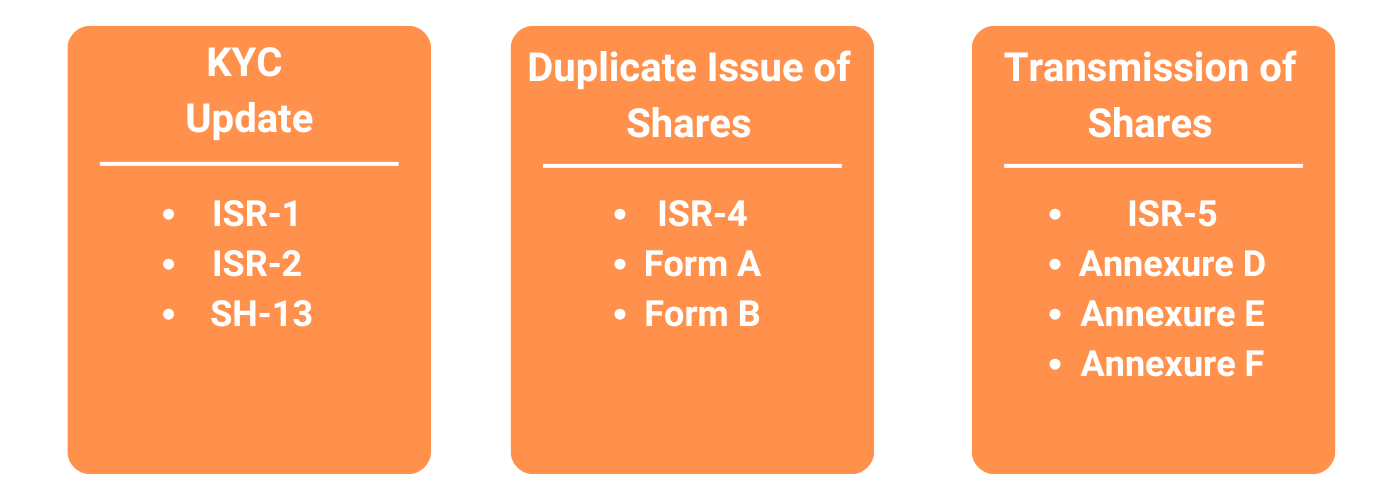
Share transmission refers to the transfer of shares by operation of law, such as in the event of the original shareholder’s death. This process ensures that shares are transferred to the rightful legal heir. Common reasons for share transmission include death, insolvency, inheritance, bankruptcy, marriage, or other statutory obligations. Once the transmission is completed, the new shareholder inherits all associated rights and benefits.
Challenges in Share Transmission and Our Support
The process of share transmission can be complex and overwhelming, especially without professional guidance. At Vida, we provide expert assistance to help resolve common challenges, such as:
- Confusion Between Share Transfer and Share Transmission: Share transfer is a voluntary act by the shareholder, while share transmission occurs due to legal obligations, such as inheritance or a will. We guide you through the legal differences to ensure clarity and compliance.
- Jointly Held Securities: In cases of jointly held shares, we help with the deletion of a deceased holder’s name or voluntary modifications as required.
- Multiple Holdings in Different Companies: Handling share transmission across multiple companies requires submitting separate documents and adhering to varying policies. Our team ensures a smooth process by managing documentation and follow-ups on your behalf.
Documents Required for Share Transmission:
- Certified copy of the death certificate
- Application for transmission from legal heirs or representatives
- Letter of Administration, Succession Certificate, or Probate of Will
- Specimen signature of the successor(s)
Service #2: Share Transfer
Share transfer involves transferring the ownership of shares from the transferor to the transferee. This process is common when legal heirs wish to transfer physical shares into their names.
How We Assist You
Transferring shares can present numerous challenges. At Vida, we address the following issues to ensure a seamless transfer:
- Recovering Lost Share Certificates: If your share certificates are lost, we assist in obtaining duplicate certificates, enabling you to reclaim your rightful ownership.
- Mismatch of Signatures: Over time, signature changes may lead to discrepancies in records. We help update your signature with the company’s records.
- Mutilated Share Certificates: Damaged certificates can hinder the transfer process. We facilitate the recovery of such shares by obtaining replacements.
- Non-Submission of Transfer Deeds: If shares remain in the seller’s name due to missing transfer deeds, we help complete the process and transfer the shares to the buyer.
Service #3: Recovery of Unclaimed Dividends
Dividends declared by companies but not claimed by shareholders for over seven years are transferred to the Investor Education and Protection Fund (IEPF). However, these dividends can still be claimed through a structured process.
How We Help
Unclaimed dividends can arise due to outdated shareholder records or negligence. At Vida, we specialize in recovering unclaimed dividends and shares by addressing the following issues:
- Expired Records: Mismatches in personal details such as name, address, or date of birth can result in dividends becoming unclaimed. We help update records to retrieve these funds.
- Improper Execution of Share Transfer or Transmission: We resolve cases where shares remain in the seller’s name or where legal heirs fail to complete the transmission process.